
ISSUE 004
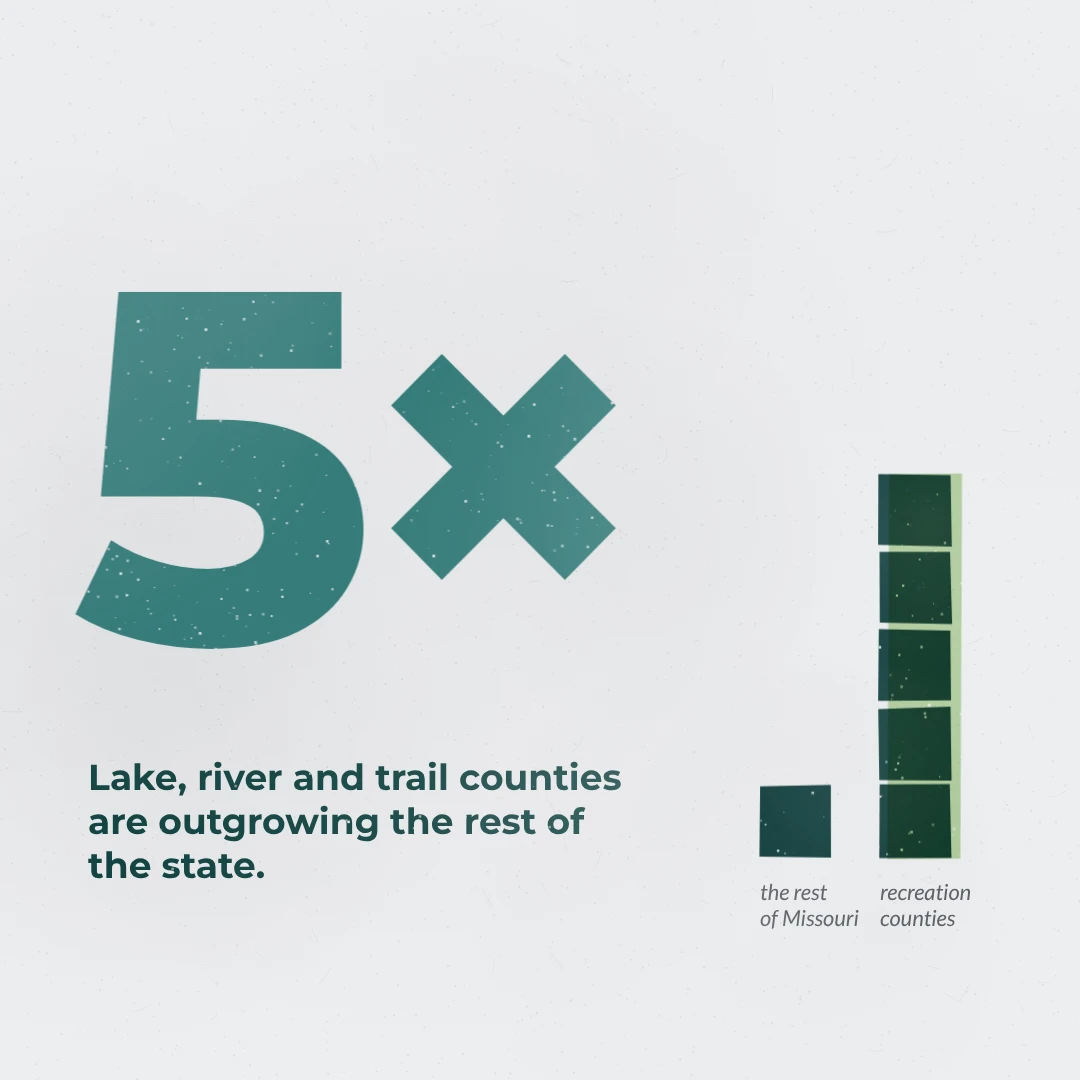
Recreation counties are growing five times faster than the rest of Missouri
There is a federal file that assigns every county in the country an economic identity — what its economy is actually built on — and I had no idea it existed until last week. Looking up Missouri's counties in it explains something the population numbers alone don't: which kinds of rural county are growing, and which aren't, are not the same question as urban versus rural.
An idea worth thinking about
The label on your county's economy is redrawn about once a decade
USDA's Economic Research Service has been classifying counties by what their economy runs on since the 1980s, updating roughly every ten years. A 2015 analysis of how the categories shifted between 2001 and the 2010-12 codes gives a sense of how much moves in a decade. Farming-dependent counties fell from 511 to 444 nationally. Manufacturing-dependent counties declined sharply. Mining-dependent counties nearly doubled, from 130 to 219.
ERS is careful to say that different vintages are not directly comparable — industry classifications change, data availability changes, qualifying criteria change. To make that particular comparison they had to recompute the 2001 codes using the newer criteria. The categories are a lens, and the lens gets reground.
What I take from it is a caution about any sentence starting "this is a farming county." That was a measured fact about a particular decade under a particular definition. Places change what they are for, sometimes within one working lifetime, and the official description arrives late. If you are making a decision about where to put something, the label is a starting point and not a finding.
A tool I disappeared into
Look up what your county's economy is officially built on
The 2025 edition of the County Typology Codes classifies every county in the fifty states and DC into six economic types and six demographic types. The economic side covers high concentration in farming, mining, manufacturing, federal and state government, recreation, or none of those. The demographic side flags low post-secondary education, low employment, population loss, housing stress, retirement destination, and persistent poverty.
There are two economic codes and the difference matters. The High Industry Concentration codes are not mutually exclusive — a county can be flagged for several industries at once, each measured independently. The Industry Dependence code is a single mutually exclusive label naming whichever industry dominates. ERS notes the dependence code identifies relatively more manufacturing-dependent counties and fewer farming, mining, government and recreation ones than the concentration codes do. Two defensible methods, two different maps.
The demographic codes overlap the economic ones, which is where it gets interesting for Missouri. A county can be recreation-dependent and housing-stressed at the same time, and I would expect some of the Ozark counties to be exactly that — growing fast and pricing out the people already there. I haven't verified that pairing; the file is free and you can check it yourself, which is rather the point.
Learn something
The rural funding programs, and who can actually apply to them
USDA Rural Development runs Missouri-specific program pages, and an hour reading them corrects two expensive misunderstandings. First, eligibility is narrower than the names suggest: Rural Business Development Grants are awarded to public bodies, tribes and nonprofits serving rural areas — not to businesses directly. The Rural Economic Development Loan and Grant program is stranger still; USDA makes zero-interest loans to local electric and telecom utilities, which pass the money through to local businesses, so your route to it runs through your co-op rather than a bank. Second, USDA defines rural as a population under 50,000, which covers far more of Missouri than people assume.
The operative skill is checking status, not memorising programs. Windows are narrow and they move. Rural Business Development Grant applications typically run a May-to-June window depending on funding allocation. The Rural Economic Development loan program runs quarterly deadlines. And as of March 2026 USDA announced it was issuing new regulations for the grant portion of the Rural Energy for America Program, pausing grant applications while guaranteed loans stayed open.
Which is the actual lesson. Any list of rural funding programs, including this paragraph, is a snapshot with a short shelf life. USDA's own advice is to talk to your state office before filling in anything, and the preparation for a real application runs from a few weeks to several months.
What we’re seeing
Before 2020 the farming and manufacturing counties emptied. Since 2020 almost every type has gained.
MU Extension applied that dependency framework to Missouri and found a reversal worth sitting with. Through the prior decade, counties dependent on agriculture, manufacturing or mining lost population. Since 2020, Missouri counties across every economic dependency except mining have posted aggregate population gains.
Recreation-dependent counties lead by a distance, growing at over 1 percent annually — roughly five times the statewide rate. MU Extension attributes that to increased remote work options and Baby Boomer retirements turning seasonal destinations into year-round ones. Farm and manufacturing-dependent counties on the outskirts of metros also gained, as remote and hybrid work let people live further from urban centres where housing costs more.
The headline reversal is that from 2020 to 2023 nonmetro counties grew slightly faster than metro ones — 0.3 percent annually against 0.2 percent. Within the metros, growth was suburban rather than central: Lincoln County outside St. Louis at 2.6 percent and Webster outside Springfield at 2.1 percent were the fastest.
This is not uniformly good news and I'm not going to present it as such. Most of the nonmetro growth landed in southwest Missouri. The Bootheel and the northern counties declined over the same period. "Rural Missouri is coming back" is false as a general statement; what's true is that proximity to a metro, or to a lake, reversed the trend, and distance from both did not.
For anyone deciding where to build something, that's a more useful map than urban versus rural. The question is what your county's economy is for, and whether the thing that changed after 2020 — people being able to work from where they'd rather live — reaches you.
One question
What is your county's economy actually built on?
Not what it was thirty years ago — now. Reply with a sentence. I want to know how often the official label and the lived answer disagree.
More in this pillar as it's written.
— Shana
Sources link to the original publisher, never to a summary.