
ISSUE 004
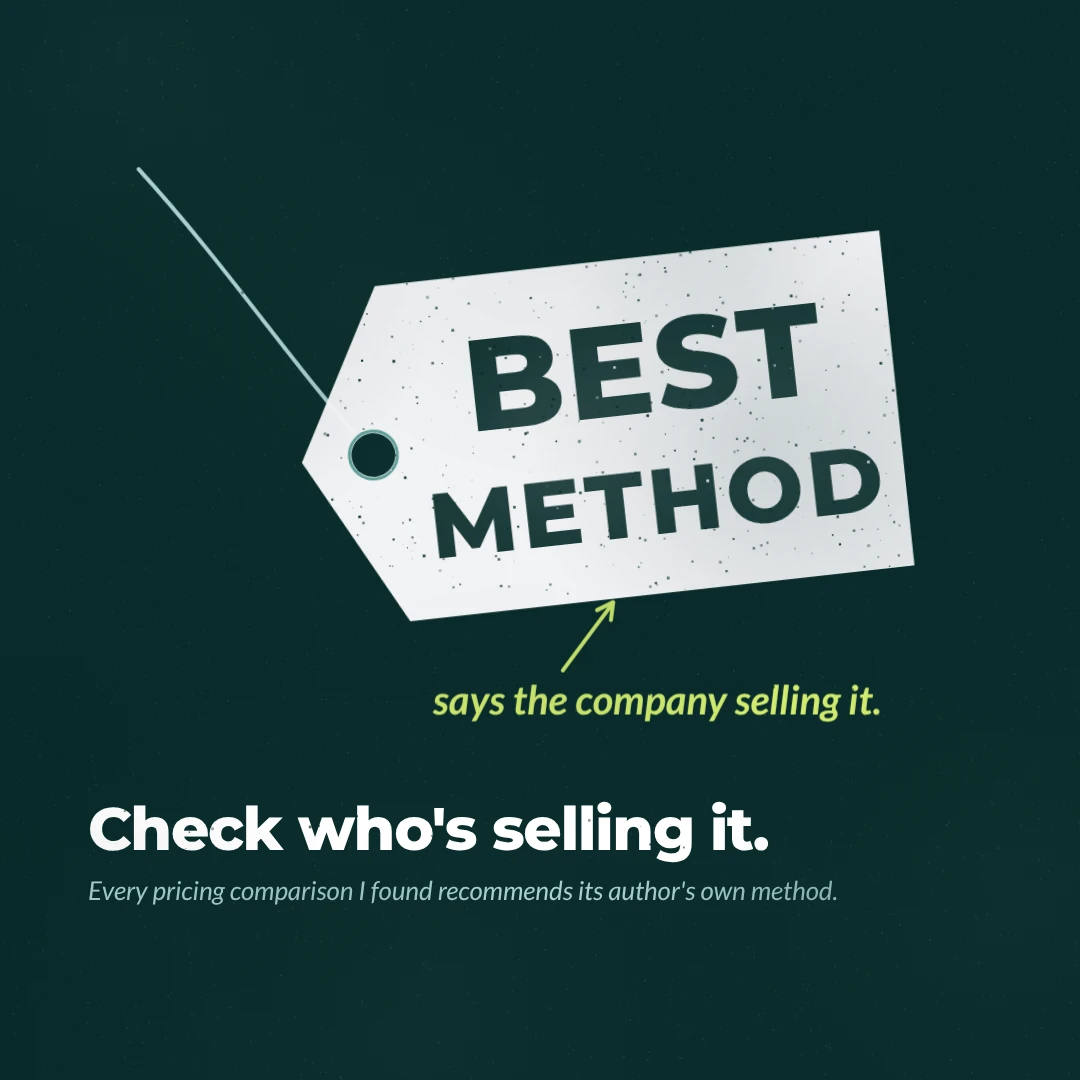
Every pricing-method comparison is written by someone selling a method
Last entry ended by saying Van Westendorp is fine for direction and wrong for a final number, and that Gabor-Granger or conjoint is what you want for actual price points. So I went to read about those. What I found first was not information about the methods, it was an argument between people who sell them.
An idea worth thinking about
The firm that sells conjoint software recommends conjoint
Sawtooth Software publishes a comparison of survey-based pricing approaches. On Gabor-Granger it concludes that it can't think of a good reason to recommend the approach. On conjoint analysis, which is the category Sawtooth sells software for, it concludes that conjoint is generally considered superior in the research community and the most widely accepted and trusted method.
I want to be careful here, because the technical arguments they make are real ones. Conjoint does model feature trade-offs that the simpler methods can't. It does handle many product variants where the others handle one. It does place the product in a competitive context, which is closer to how buying works. None of that is invented.
But read three or four of these comparisons and the pattern is unmistakable: the recommended method is the one the author sells, every time. Consultancies that run conjoint studies recommend conjoint. Survey platforms with a Van Westendorp template explain when Van Westendorp is appropriate. This is the same structure as the succession advice in the Startup Development pillar, where nearly every estimate came from someone paid on transactions. You don't need to assume bad faith. You need to check what the author is selling before you weigh the recommendation, and that information is usually one click away.
A tool I disappeared into
Ask yes or no at a price, then move the price
Gabor-Granger, published by Gabor and Granger in 1966, is almost aggressively simple. Show someone a clearly defined offer at a specific price and ask whether they'd buy: yes or no. If yes, ask again higher. If no, ask again lower. Repeat across a set of price points and you get an acceptance curve, from which fall out a demand curve, a price elasticity, and a revenue-maximising price point.
That's more than Van Westendorp gives you, and it's the reason to reach for it: Van Westendorp maps an acceptable range from perception, Gabor-Granger quantifies purchase incidence at prices inside that range. Practitioners describe the sensible sequence as using the first upstream to set the corridor and the second to work within it. Both typically want 200 to 300 respondents; conjoint wants 300 to 500 or more.
The limitations are stated candidly even by people selling it, which is worth crediting. It assumes one fixed offer, so it can't design tiers or bundles. It has no competitive context and won't tell you about switching. It's vulnerable to anchoring from the starting price and to the granularity of your price grid — too few points or too narrow a range produces misleading peaks. And it's hypothetical, with everything that implies from the last entry. One consultancy's own recommended fix is to validate the result with A/B tests, which is a notable thing for a survey method to require.
Learn something
Why the expensive method is more realistic
Choice-based conjoint presents people with whole product profiles — a set of features at a price — and asks them to choose between them, repeatedly. Statistical modelling then separates out how much each attribute and each price level contributed to the choices, producing attribute utilities, feature importance and price sensitivity across potentially thousands of product variants.
The case for it rests on one observation that I think is correct regardless of who's making it: nobody in real life ever chooses a price. They choose a thing that has a price, in the presence of alternatives that have prices. A method that asks about price in isolation is asking a question no customer ever faces, which is why the answers drift.
The catch for a business your size is the arithmetic. Conjoint wants 300 to 500 or more respondents, more if you want to segment, plus the statistical work to model the results. If you have 400 customers total, you cannot run a 400-respondent study on them and also keep them as customers. Understanding the method is still worth an hour, because it tells you what a good answer would look like — and therefore how much to discount the cheaper answer you're going to use instead.
What we’re seeing
All three methods need more respondents than you have. The one that doesn't is changing the price.
Line up the three survey methods by what they need and the problem becomes obvious. Van Westendorp: 200 to 300 respondents. Gabor-Granger: 200 to 300. Conjoint: 300 to 500 or more, and more again for segments. These numbers come from the people who run these studies, so if anything they are the friendly version.
A business with 80 customers cannot produce a statistically meaningful pricing study about itself. That is not a failure of ambition, it's arithmetic, and I think a lot of small business owners conclude from it that proper pricing research is something other people do and quietly go back to cost-plus.
The thing worth noticing is what the methods literature says when it's being careful. Gabor-Granger's own limitation list recommends validating results with A/B tests. The validity research in the last entry established that hypothetical methods are only trustworthy to the degree they've been checked against designs where somebody might actually pay. In both cases the gold standard being referenced is: charge a different price and see what happens.
You have that. It's the one research instrument a small business owns outright and a large one struggles to use. Raise the price on one service line for a quarter. Quote two different numbers to two similar prospects. Offer the new tier at $60 to the next ten callers and $45 to the ten after that. The sample is small and the conditions are messy — but every answer is incentive-aligned, because the person either paid or didn't.
Which is where this pillar's four entries land. Simulated customers can't predict individuals. Real customers can't reliably predict themselves. Survey methods are trustworthy in proportion to how well they've been validated against actual purchases. And the methods literature is written by people selling methods. Under all of it sits one durable check that costs nothing: somebody paid, or they didn't.
One question
What happened the last time you raised a price?
Did anyone leave? Reply with what you changed and what followed — that's a real experiment and almost nobody writes them down.
More in this pillar as it's written.
— Shana
Sources link to the original publisher, never to a summary.