
ISSUE 004
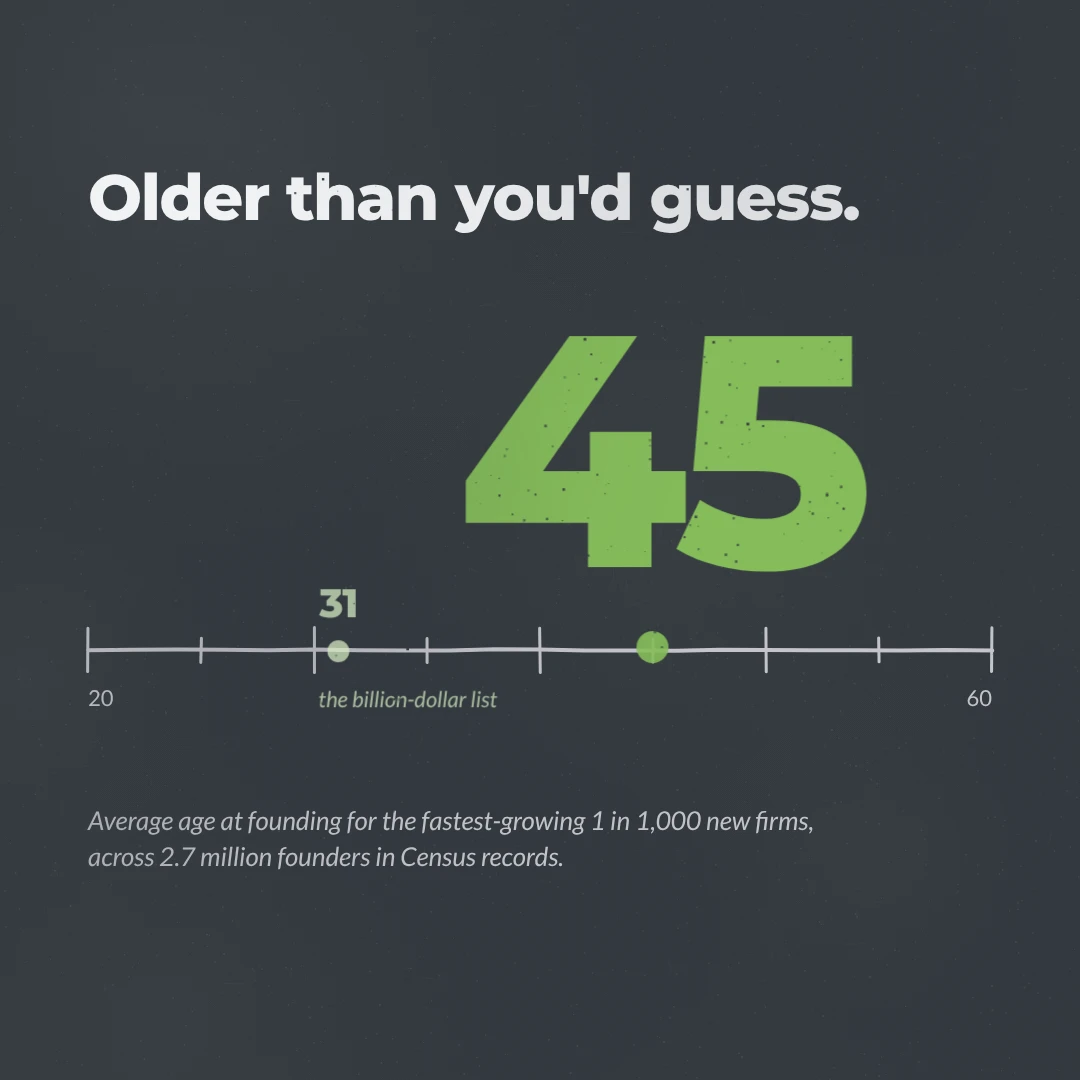
The average founder of a top-growth company is 45
Three entries in this pillar have now been exercises in handling weak evidence carefully. This one is the opposite and it's a relief to write. The finding is counterintuitive, it comes from Census administrative records rather than a survey, and it has direct consequences for who gets taken seriously in a room here.
An idea worth thinking about
There is no industry where the average founder is under 38
The researchers broke their results down by sector at a fine grain — 315 industry categories — and the distribution is the part that surprised me more than the headline. Computing-oriented and wireless telecom ventures have the youngest founders, and even there the mean age at founding runs from 38.5 to 40.8. The oldest technology sectors, which involve manufacturing and oil and gas, run from 47.3 to 51.4.
Across all 315 sectors, not one has a mean founder age below 38. Only three are below 40.
Hold that against the image the word "founder" summons. The paper notes that a Wall Street Journal list of billion-dollar startups showed a mean founder age of 31, which is roughly where public imagination sits — and which describes an extremely small and unrepresentative tail. If you are 44 and have spent twenty years in a trade, the data says you are not late. You are approximately on time, and slightly early for manufacturing.
A tool I disappeared into
Economics papers, free, before they disappear behind journals
The National Bureau of Economic Research publishes working papers as open PDFs, and this one is a good demonstration of why that's worth knowing about. The version in the American Economic Review: Insights sits behind a journal; the working paper is the same research, free, with more of the tables intact.
For anyone who wants to check a claim rather than accept a summary of it, this is the layer where economics arguments actually live. Tables in the paper include the sector breakdowns, the hub-by-hub comparisons, and the exits analysis — material that gets compressed to a single number by the time it reaches a headline.
The habit worth forming: when a business statistic gets cited widely, look for whether there's an NBER working paper underneath it. Often there is, often it's free, and often it says something more qualified than the version being quoted at you.
Learn something
The short version, written by the people who did the work
Kellogg publishes accessible write-ups of its faculty's research, and the summary of this paper is the version to hand to someone who won't read forty pages of econometrics. Benjamin Jones, one of the four authors, describes the finding plainly and admits he found it surprising himself.
It's worth reading alongside the paper rather than instead of it, because the summary necessarily drops the qualifications. What survives compression is the core claim: among the very fastest-growing new technology companies, the average founder was 45 at founding, and the wunderkind picture is not supported.
If you want the even shorter version to send someone, the same authors published it in Harvard Business Review in 2018 under a title that is simply the finding: the average age of a successful startup founder is 45.
What we’re seeing
Across 2.7 million founders in Census records, the mean age at founding was 41.9. For the top one in a thousand, 45.
Azoulay, Jones, Kim and Miranda used administrative data at the US Census Bureau to study every founder who started a company that went on to hire at least one employee between 2007 and 2014 — 2.7 million people. Mean age at founding: 41.9. For the one in a thousand fastest-growing new ventures, 45.0. High-technology sectors came out similar, from 41.9 to 44.6 depending on the definition, with founders of patenting firms at 44.6.
This is a different class of evidence from anything else this pillar has run. It isn't a survey and it isn't a set of post-mortems written by people managing their reputations. It's administrative records covering a full population, published in a peer-reviewed economics journal. The authors state the conclusion flatly: the findings strongly reject common hypotheses that emphasise youth as a trait of successful entrepreneurs, and they find no evidence that founders in their twenties are especially likely to succeed.
Now the mechanism, because the comfortable reading of this is wrong. Age is not the active ingredient. The paper finds that prior experience in the specific industry predicts much greater rates of entrepreneurial success. Middle-aged founders do better largely because middle-aged people have usually spent fifteen years inside the industry they are now entering. A 48-year-old starting a business in a field they have never worked in gets no benefit from this finding.
Which makes it a fairly specific instruction rather than reassurance. The advantage is transferable domain knowledge, and it compounds. If you have run a parts counter for eighteen years, the business you should start is probably adjacent to parts counters — not the app you thought of last month.
One limit to state: the paper covers foundings from 2007 to 2014 and was published in 2018 and 2019. I could find no equivalent rerun on more recent Census data. The underlying relationship between domain experience and success is not the sort of thing that flips in a decade, but the specific numbers are a decade old and should be quoted that way.
One question
How many years have you spent in the industry you're building in?
A number. The research says this is the variable that matters, so I'm curious what the honest distribution looks like among people reading this.
More in this pillar as it's written.
— Shana
Sources link to the original publisher, never to a summary.