
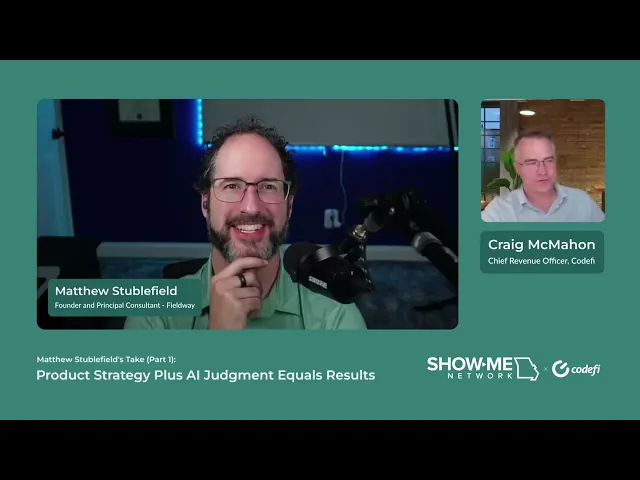
If you've ever sat in a corporate job thinking "I could do this on my own," Matthew Stublefield's story will feel familiar. So will the part where knowing you should leave and actually leaving turned out to be two very different problems.
Matthew is the founder of Fieldway, a product management consulting practice he launched in 2025 after more than 20 years in tech, helping software teams work through product strategy, market expansion, and customer journey questions. But the version of Matthew who eventually built Fieldway isn't the version who first tried.
The corporate detour that wasn't a detour
Matthew's path toward solopreneurship started in 2022, after a difficult experience at an edtech company. He formed an LLC with the intention of consulting independently — and then took a corporate job instead. Not because the independent path felt wrong, but because his family needed health insurance, and that's not a small thing to walk away from.
What followed wasn't comfortable. Matthew describes enduring eight separate rounds of layoffs during his time in that role. Instead of treating the uncertainty as a reason to freeze, he treated it as a countdown — using weekends and evenings over 13 months to build an e-learning course and set aside savings, quietly constructing the exit while still doing the job that was paying for it.
That's the part most "I quit my job" posts skip: the leap didn't happen in a moment. It happened in the margins, over more than a year, before anyone else knew it was coming.
The launch that didn't work — and the five months that followed
When Fieldway officially launched in June 2025, Matthew ran a coordinated LinkedIn announcement. It generated real visibility — strong impressions, plenty of eyes on the launch. It did not generate a single course sale or coaching client.
What came next is the part most people don't talk about: five months of testing across workplace grief, team communication, and conflict resolution — not because he lacked direction, but because he needed the market to tell him where his experience actually mattered. Visibility had told him people were watching. It hadn't told him what they'd pay for.
The turning point came through a conversation at his church, of all places. Someone advised him to stop marketing specific training topics and start naming the problem he actually solved: delivery struggles inside software teams. That reframe — from "here's a course I built" to "here's the high-stakes question I can answer for you" — is what turned Fieldway from an idea into a business.
It also settled something Matthew had been wrestling with: whether to niche down into one narrow technical lane, or lean into being a generalist. Influenced by the book Range, he chose the latter. His value, he concluded, isn't a single vertical skill — it's the strategic judgment that comes from connecting pieces other people don't see as connected.
What building without a net actually cost — and what it gave back
Ask Matthew what solopreneurship requires and he won't just tell you about the upside. He's direct about the trade-offs.
On the positive side: he now invests directly in his own equipment, tools, and health, instead of routing those decisions through an employer. Leaving employer-linked health insurance behind — he now carries a plan through the Missouri Chamber Benefit — was a genuine relief, not just a logistical fix.
On the harder side: contracting is isolating in ways a corporate job isn't. Matthew points specifically to going through a personal grief event without the built-in camaraderie of coworkers around him — while still needing to stay billable. There's no team lunch, no hallway check-in, no one automatically covering for you.
That tension — independence without infrastructure — is a big part of what "sustains him now." Matthew manages it by protecting his financial runway deliberately, splitting his time between client delivery and business development (referrals and direct outreach), and resisting the urge to scale before the business is actually ready. His advice to other new entrepreneurs is blunt: manage your budget carefully, separate your personal identity from your job title, and — if it turns out entrepreneurship isn't the right fit — be willing to walk toward a different path instead of forcing one that doesn't work. It suits him. He's clear that it doesn't suit everyone.
One thing he flagged early — that Part 2 goes deep on
Matthew also raised something we're dedicating the entire next conversation to: what he calls the "cheap yes" — the way AI tools can hand founders confident-sounding answers that skip right past the judgment those answers actually require. He uses AI heavily for research and productivity. He's also clear that it's not a substitute for real-world validation.
That tension — AI creating speed without necessarily creating direction — is exactly where Part 2 of this series picks up.
You don't have to build your direction alone
Matthew's story surfaces two problems a lot of early-stage founders recognize: knowing something is worth pursuing but not knowing what to do next, and the isolation of figuring it out without a network behind you. Add AI into the mix, and there's a third — the speed to build something fast without any signal on whether it's the right thing to build.
That's part of what Codefi and the Show-Me Network are built for — Traction Studio AI pairs real customer discovery with AI-powered synthesis, compressing months of market-signal gathering into days so founders build what the market will actually buy, and the Show-Me Network's regional partners provide the community Matthew described missing. If any of that sounds familiar, explore both at codefiworks.com
Want to work with Matthew directly? Learn more about his product strategy consulting at Fieldway
Watch for Part 2, where Matthew gets specific about how AI changed what he could build and earn on his own — including where AI's judgment stops and his has to start.
Learn fast. Build right. Gain traction.
Relevant Links
https://fieldway.org/
http://codefiworks.com
https://showmenetwork.org/