
You shipped a working prototype. Maybe it took a weekend. Maybe three. Cursor or Bolt or Replit made the build feel almost effortless. And then you launched — posted it somewhere, told people about it — and almost nothing happened.
Not because the product was bad. Not because you didn't work hard enough. Because you built something before you knew anyone wanted it.
This is the most predictable startup failure mode. 42% of companies that fail name “no market need” as the cause — not funding, not competition, not team problems. The product just didn't match what customers actually needed.
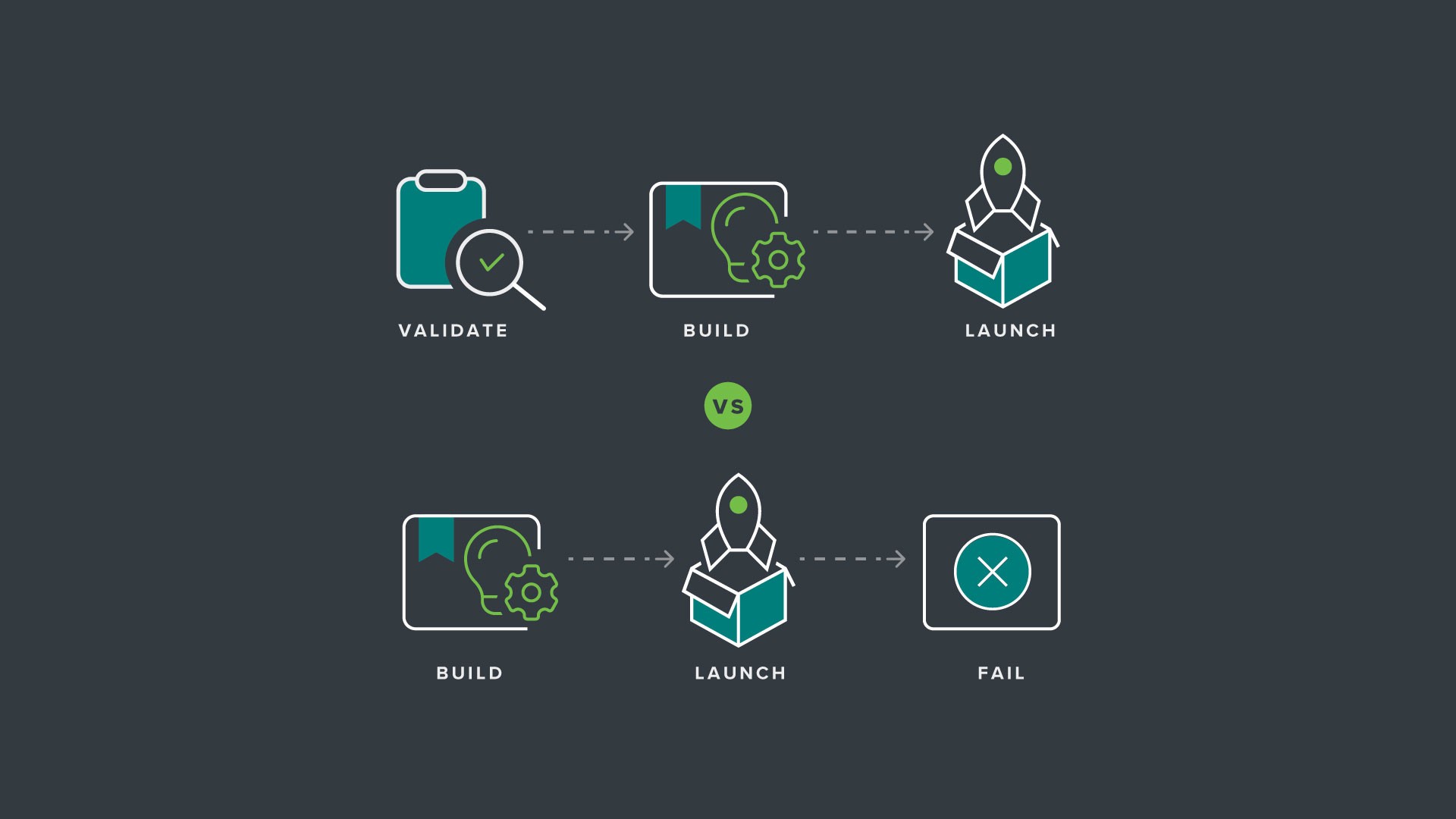
The painful part: it's almost entirely preventable. The fix isn't building better. It's changing the sequence.
The Validation Gap
Here's why it happens anyway.
Building is energizing. There's nothing quite like seeing a product take shape — a working prototype, a functioning feature, something you can put in front of someone and say “I made this.”
Talking to customers before you've built anything feels abstract, even unnecessary. You have a vision. You understand the problem. Why slow down to ask questions you think you already know the answers to?
Because you might be wrong. And discovering that after six months of development is catastrophically more expensive than discovering it after six conversations.
Validation is this: before you build, confirm that real people have a real problem, that they're actively looking for a solution, and that they'd pay for what you're planning to build. It sounds obvious. Most founders still skip it.
What Good Validation Actually Looks Like
A lot of what passes for validation isn't.
Posting on Product Hunt and getting upvotes isn't validation. Friends telling you the idea is interesting isn't validation. A one-question survey isn't validation.
Real validation involves structured conversations with people who might actually be your customers. Not pitching them — listening to them. Understanding how they currently deal with the problem you're solving. What they've tried before. What frustrated them about those solutions. Whether this is a priority they'd spend money on, or something they've learned to live with.
The goal is insight, not confirmation. You're not trying to prove you're right. You're trying to learn whether you are.
Systematic customer discovery — typically 10 to 20 structured conversations — using proven interview frameworks surfaces signal instead of noise. Synthesizing those conversations with AI identifies patterns across interviews that humans would miss reviewing notes manually: the objection that shows up in seven different forms, the priority that appeared in every single conversation, the assumption the founder held that turned out to be completely wrong.
Three Dimensions of Validation
Most founders who do validate only check one dimension: desirability. Do people want this?
A complete picture requires three.
Desirability: Do people want what you're building? Is this a real problem, not a hypothetical one? Would they pay for a solution?
Viability: Can you build a sustainable business around it? Is the market large enough? Can you acquire customers at a cost that makes sense?
Feasibility: Can you actually build it — given your team, your timeline, and your resources?
A startup that's desirable but not viable fails when it runs out of runway. One that's desirable but not feasible gets beaten to market by a better-resourced competitor. Validation that checks all three gives you a real foundation — not just a confident feeling.
The Vibe Coding Problem
If you've been following the vibe coding movement — founders shipping working prototypes in hours or days using tools like Cursor, Bolt, and Replit — you already know how much the speed of building has changed.
What hasn't changed is the importance of building the right thing.
Vibe coding is a superpower. It compresses months of development into days. But that same speed makes the cost of skipping validation even higher, because you can now invest enormous effort in the wrong direction in very little time.
The founders who win aren't the ones who build fastest. They're the ones who validate fast — and then build fast. The sequence is the advantage.
When to Validate
Before you write production code. Before you hire. Before you fundraise.
Ideally, before you build anything more than a rough sketch of what you're planning.
The earlier you validate, the cheaper it is to be wrong. A pivot based on three weeks of customer discovery costs almost nothing. A pivot based on six months of product development costs everything — runway, team morale, sometimes the company.
You don't need a product to validate. You don't even need slides. You need a clear articulation of the problem you believe exists and a genuine curiosity about whether you're right.
What Happens After Validation
Validation isn't the end of the process. It's the foundation of everything that comes after.
A validated business model tells you what to build first, who to build it for, and how to talk to them in a way that converts. It gives you the ICP clarity that makes your go-to-market strategy coherent. It gives you the customer language that makes your marketing land.
Traction Studio AI is designed around this connection. Ideation is the validation layer — customer discovery, business model design, pitch and asset generation. Incubation takes what you learned and turns it into execution: go-to-market planning, product development, early pipeline management. Acceleration uses what Incubation produced to prepare you for product-market fit measurement
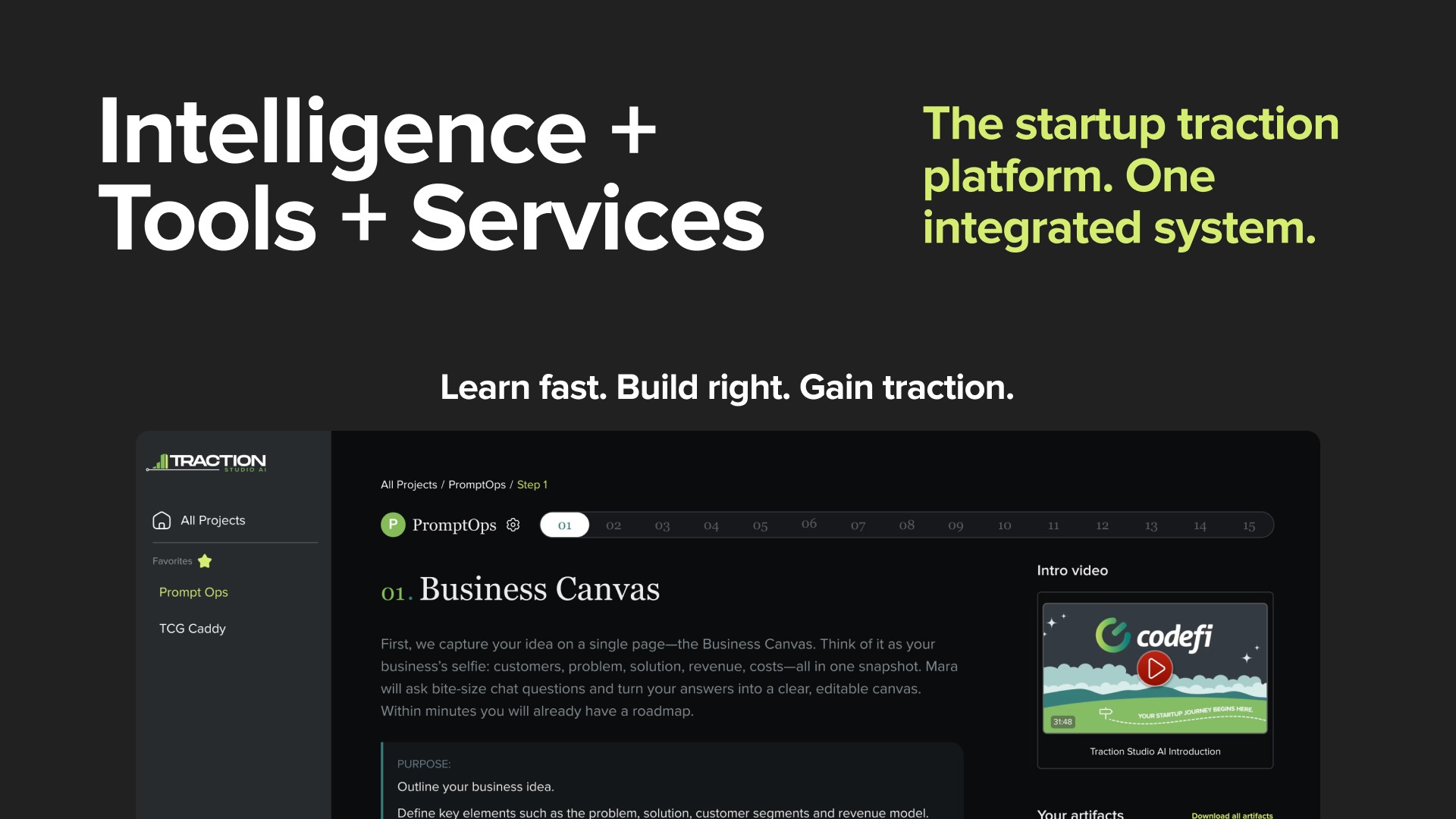
Everything connects. What you learn in validation shapes what you build. What you build shapes how you go to market. How you go to market determines whether you raise money at all.
The founders who get this right aren't smarter or luckier than the ones who don't. They did the work in the right order.
Start with validation. Everything else follows.
Traction Studio AI Ideation is live now. Incubation is Coming Soon. Missouri founders can access Ideation at no cost through Codefi Foundation. National founders can subscribe through Codefi, Inc.
Register at app.tractionstudio.ai
Learn fast. Build right. Gain traction.